How to Style a Console Table
A console table is one of the few pieces of furniture that has to be both functional and photogenic at the same time. It catches your keys on the way out the door and it’s the first thing guests see, which means styling it well is less about decor theory and more about balancing both jobs at once.
Choose the Right Size and Height First
A console table behind a sofa should sit slightly lower than the sofa’s back, typically 30 to 36 inches tall, and its length should be roughly two-thirds the length of the sofa, not longer. An entryway console can run a bit taller, up to 36 inches, since it usually stands alone rather than behind another piece of furniture.
Depth matters more than people expect in tight hallways. A console under 14 inches deep keeps a narrow walkway usable, while anything deeper than 18 inches starts to compete with foot traffic in a standard hallway width.
The Rule of Three Zones
Think of a console table as three visual zones: a taller anchor piece on one end (a lamp, a large vase, or leaning art), a mid-height grouping in the center (a stack of books topped with a small object, or a bowl), and a smaller, functional zone on the other end (a tray for keys and mail, or a small dish).
This structure keeps the table from feeling either too formal (all matched and symmetrical) or too chaotic (objects scattered with no organizing logic). The asymmetry between the three zones is what makes it read as styled rather than assembled.
| Zone | Purpose | Example |
| Tall anchor | Draws the eye upward, adds height | Table lamp, leaning mirror or art |
| Mid-height grouping | Fills the visual center | Stacked books with a small object on top |
| Functional zone | Handles everyday use | Catch-all tray, small bowl for keys |
Entryway Consoles Need to Work Hard
An entryway console is the piece most likely to accumulate mail, mask keys, and random clutter within a week of being styled, so build the function in from the start rather than fighting it later. A tray, no matter how small, gives loose items a defined home instead of letting them spread across the whole surface.
A small drawer or a woven basket underneath adds hidden storage for things you don’t want visible daily, like sunglasses or dog leashes, while keeping the tabletop itself reserved for the styled elements.
Behind-the-Sofa Consoles Serve a Different Purpose
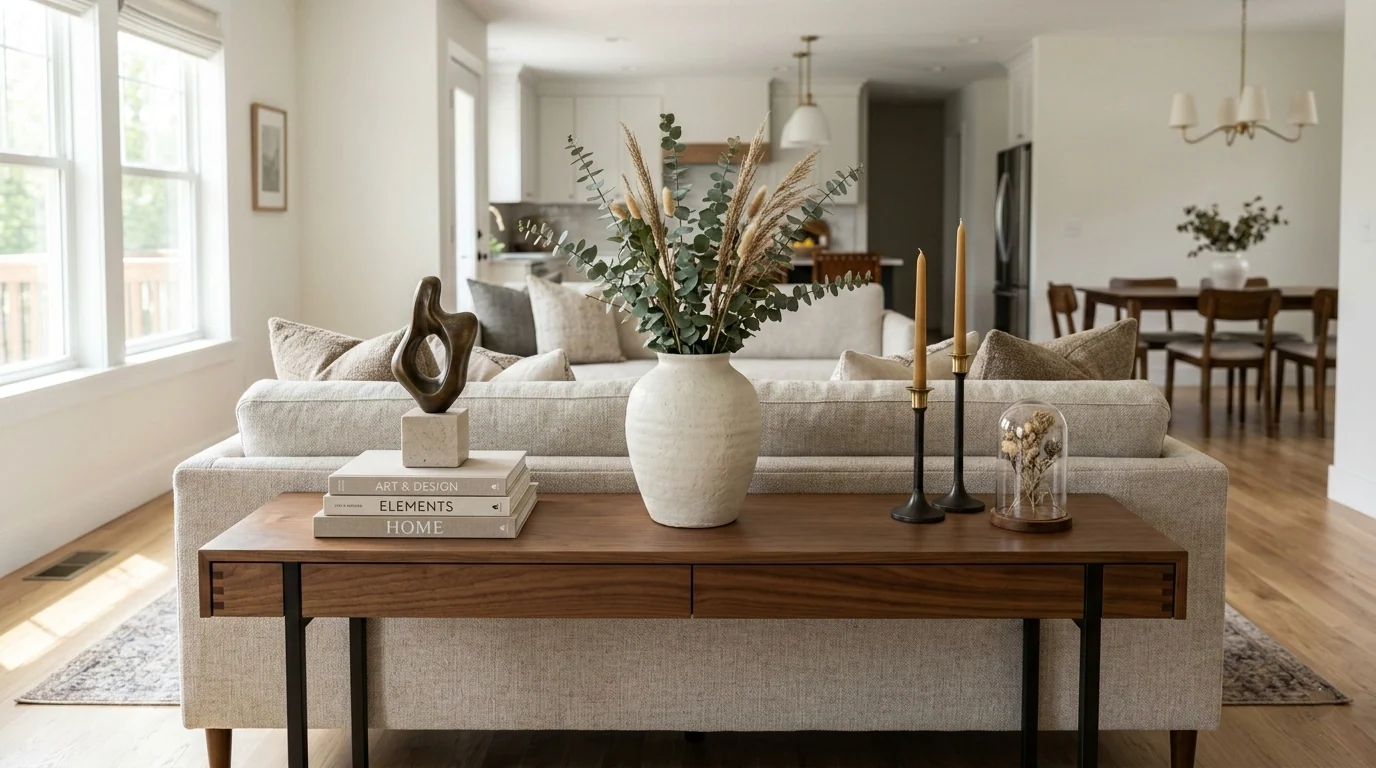
A console placed behind a sofa (usually in an open floor plan where the sofa’s back faces a walkway) works best styled a bit more sparsely than an entryway table, since it’s viewed primarily from a distance across the room rather than up close.
One taller lamp, one mid-height plant or vase, and a single stack of books is often enough here. Overloading a behind-sofa console with small objects tends to disappear visually from across the room anyway, so simplicity actually reads better at that distance.
Mirror or Art Above the Console
A mirror or piece of art hung above a console, sized to roughly two-thirds the width of the table below it, ties the whole vignette together and gives the eye somewhere to travel upward. Hang it so the bottom edge sits 6 to 8 inches above the tabletop, close enough to feel connected but with enough breathing room that nothing looks crowded.
In an entryway specifically, a mirror does double functional duty, giving you a last look before heading out the door, which makes it one of the more practical choices for that particular zone even beyond its decorative value.
Seasonal Refreshing Without Buying New Furniture
A console table is one of the easiest surfaces in a home to refresh seasonally, since the table itself and the anchor lamp usually stay put while the mid-height grouping and small objects rotate. Swap a bowl of fresh greenery for something warmer-toned in winter, or change out the books in the mid-height stack to match a seasonal color palette, without touching the furniture or the wall art above it.
Choosing a Console Table Shape for Tight Spaces
In very narrow hallways, a demilune or half-round console hugs the wall closely while still offering surface area, since its curved front avoids the sharp corner of a rectangular table that people tend to catch a hip on in tight passageways. Console tables with an open X-base or slim metal legs also read as lighter in a narrow space than a solid-sided cabinet style, which can make an already tight hallway feel more closed in.
For a genuinely tiny entry, a wall-mounted floating shelf styled the same way as a console (using the same three-zone approach) accomplishes the same visual goal without requiring any floor footprint at all.
Placing a Console Table Behind a Sofa the Right Way
Beyond height and length, leave at least 6 to 8 inches of clearance between the console and the sofa back so the table doesn’t bump into the cushions every time someone leans back. If your open floor plan doesn’t allow that clearance, a slimmer, shallower console (under 12 inches deep) usually solves the spacing problem without sacrificing the visual anchor a console provides.
In homes without a clear walkway behind the sofa, skip the console entirely rather than forcing one into a space that will constantly be bumped or blocked. A slim floating shelf mounted on the wall behind the sofa achieves a similar visual layering effect without requiring floor clearance at all.
Choosing a Base Style: Legs, Panels, or Pedestal
An open-leg console, whether four straight legs or a slim X-base, reads as lighter and works especially well in smaller rooms since you can see floor and baseboard continuing underneath it. A solid-panel or cabinet-style console feels more substantial and anchors a larger room well, but can visually close off a tight hallway if the space doesn’t have much width to spare.
A pedestal-style console, with a single central support rather than legs at each corner, splits the difference nicely in awkward or narrow spaces, since it avoids the visual bulk of side panels while still feeling more grounded than thin individual legs.
Console Tables With Built-In Storage
If your entryway or hallway lacks a coat closet, a console with drawers or a lower shelf becomes more than a decorative surface, it becomes genuine storage for gloves, scarves, or dog leashes that would otherwise clutter a hook by the door. A woven basket on the lower shelf softens the look of a storage-focused console while still keeping items corralled and out of sight.
In a living room setting, a console with a lower shelf can also double as extra media storage, holding a stack of board games or extra throw blankets without needing a separate piece of furniture dedicated to that purpose.
Frequently Asked Questions
How tall should a console table be?
Generally 30 to 36 inches, with a table behind a sofa sitting slightly lower than the sofa’s back and a standalone entryway console able to go a bit taller.
How many objects should be on a styled console table?
Between five and eight objects, organized into a tall anchor, a mid-height grouping, and a functional zone, usually looks balanced. Fewer than that can look sparse, while more starts to feel cluttered.
Should a console table behind a sofa be shorter than the sofa?
Yes, ideally a few inches shorter than the sofa’s back height, and roughly two-thirds the sofa’s length, so it doesn’t visually overpower the seating piece in front of it.
What’s the best way to keep an entryway console from getting cluttered?
Build in a designated tray or small bowl specifically for keys, mail, and everyday items from the start. Without a defined spot, loose items spread across the entire surface within days.
How big should a mirror above a console table be?
Roughly two-thirds the width of the console below it, hung with the bottom edge about 6 to 8 inches above the tabletop for a connected, balanced look.
What console table shape works best in a narrow hallway?
A demilune or half-round console hugs the wall closely and avoids the sharp corner of a rectangular table, which is easier to navigate around in a tight passageway.
How much clearance do I need behind a sofa for a console table?
At least 6 to 8 inches between the console and the sofa back, so the table doesn’t bump into the cushions whenever someone leans back. If that clearance isn’t available, a shallower console under 12 inches deep usually solves it.
Should a console table have legs or solid side panels?
Open legs read as lighter and work well in smaller rooms since floor continues underneath, while solid panels feel more substantial and anchor larger rooms better. A pedestal base is a good middle ground for narrow or awkward spaces.
Final Thoughts
A console table looks styled when it has a clear structure, a tall anchor, a mid-height grouping, and a functional zone, not when every inch is filled with decor. Get the height and depth right for the space, build in real storage for everyday clutter, and let a mirror or art above tie the whole vignette together.