How to Create a Reading Nook in a Small Space
A reading nook doesn’t need its own room, it needs about 25 square feet, one comfortable chair, and lighting that doesn’t strain your eyes. The mistake most people make is waiting for a spare room that will never appear, instead of carving a nook out of space they already have.
Find the Right Spot Before Buying Anything
A reading nook works best tucked into an underused corner, not carved out of your main living or walking space. Look at awkward corners first: the dead space beside a bookshelf, an unused corner of a bedroom, the end of a hallway that dead-ends at a window, or the space under a stairwell.
Natural light matters more here than in almost any other small-space project. A spot near a window, even a small one, will get more actual use than a technically larger corner with no daylight, since most people read during the day or in the early evening when natural light is available.
Choose Furniture Scaled to the Space
A single accent chair, ideally one with some visual weight but a compact footprint (armless or slim-armed designs work well in tight corners), anchors the nook without overwhelming a small area. Swivel chairs or chairs that rotate slightly are especially useful in corners where you also want to occasionally face into the room rather than only toward the window.
Skip the full-size ottoman if space is under 4 feet square; a small pouf or a low stool that can double as a side table when not being used as a footrest does the same job with a much smaller footprint.
| Available Space | Furniture Approach | Notes |
| Under 15 sq ft | Chair only, wall-mounted shelf for books | Skip a separate side table entirely |
| 15-25 sq ft | Chair, small side table, floor lamp | Add a small pouf if it fits without crowding |
| 25+ sq ft | Chair, ottoman, side table, floor lamp, small bookshelf | Full nook with dedicated storage |
Lighting Makes or Breaks a Reading Nook
Overhead ambient lighting alone is almost never enough for comfortable reading. A dedicated floor lamp positioned just behind and slightly to the side of the chair, at a height where the bulb sits above your shoulder when seated, provides direct light on the page without glare or shadow from your own hand or the book itself.
Warm bulbs in the 2700K to 3000K range keep the nook feeling relaxing rather than clinical, and a lamp with an adjustable arm or swivel head gives you flexibility to redirect the light depending on the time of day and how much natural light is coming through the window.
Add Storage Within Arm’s Reach
A reading nook without a place to set down a book, a cup of tea, and a pair of glasses stops feeling like a functional space and starts feeling like just a chair in a corner. A small side table, even a narrow C-table that slides partially under the chair’s arm, solves this in almost any footprint.
For book storage, a wall-mounted shelf directly beside or above the chair keeps your current reading pile visible and accessible without requiring a full bookshelf’s floor footprint. This is especially useful in nooks under 15 square feet where a freestanding bookshelf simply won’t fit.
Layer in Texture and Softness
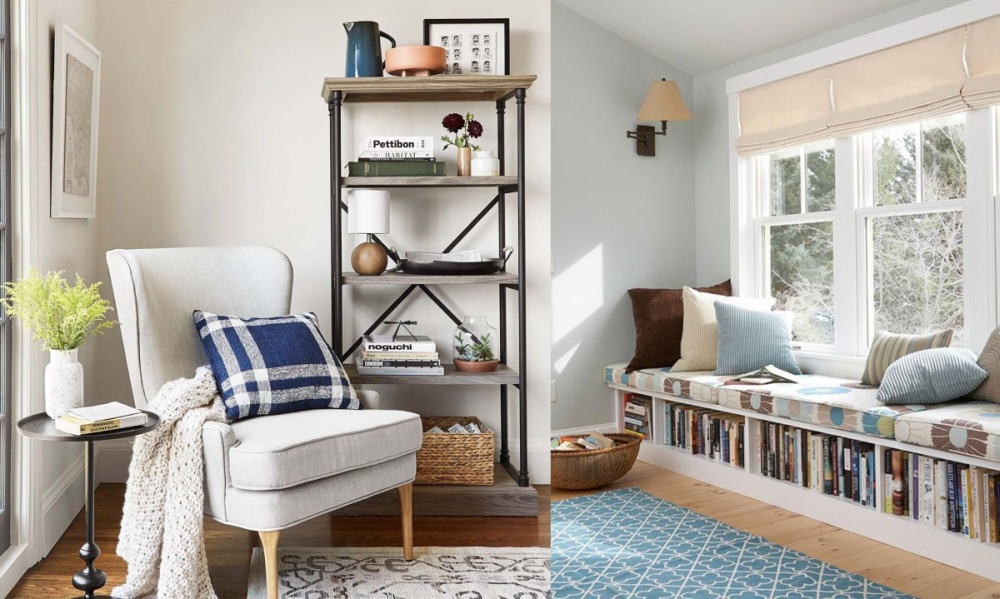
A reading nook is meant to feel like an invitation, which means texture matters more here than in a purely functional corner. A soft throw blanket draped over the chair’s arm, a textured area rug underfoot even in a small footprint, and a supportive lumbar pillow all signal that the spot is meant to be used and lingered in, not just decorated.
If the nook sits in a shared space like a living room, a small room divider, a tall plant, or even the back of a bookshelf can visually separate it just enough to feel like its own zone without requiring an actual wall.
Making a Window Seat Work as a Reading Nook
A window with a deep enough sill or a built-in bench, even a shallow 12-inch ledge, can become a reading nook with the addition of a fitted cushion and a couple of supportive back pillows. Measure the sill’s exact dimensions before ordering a cushion, since standard sizes rarely match a built-in window ledge precisely, and a cushion that’s even an inch too large will bunch uncomfortably at the corners.
For deeper window seats, adding a small shelf or ledge along one side gives you the same functional surface a side table would provide in a freestanding nook, without needing to fit an actual piece of furniture into the window recess.
Sound and Privacy in a Shared-Space Nook
If your reading nook sits within an active family room or open living area, consider how much sound isolation you actually need before assuming a corner won’t work. A high-backed wingback style chair naturally blocks peripheral distraction and creates a slight sense of enclosure even without any physical divider, which makes it a smart choice for nooks in busy, shared spaces.
Noise-dampening elements, a rug underfoot, curtains nearby, even a small upholstered headboard-style panel behind the chair, all soften ambient sound in a way that makes a nook feel more like its own retreat even a few feet from an active television or a busy kitchen.
Small Additions That Make a Nook Feel Finished
A small basket beside the chair for current reads, rather than a stack balancing precariously on the side table, keeps the whole corner feeling tidy even with several books in rotation. A wall hook nearby for a robe or a bag also quietly signals that this spot gets regular, intentional use rather than sitting decorative and untouched.
Scent is worth considering here too. A candle or diffuser placed nearby, chosen in a calming, warm scent, turns the nook into more of a sensory retreat rather than just a visually pleasant corner, which matters for a space specifically meant to encourage slowing down.
Choosing Between a Chair and a Daybed Setup
A single accent chair suits nooks primarily used for shorter reading sessions or as a quiet spot for morning coffee, while a daybed or chaise works better if the nook doubles as an occasional nap spot or a longer weekend reading habit. Daybeds need considerably more floor space, generally at least 30 square feet including clearance, so they’re the better fit for a converted spare corner of a bedroom rather than a tight hallway nook.
Frequently Asked Questions
How much space do I need for a reading nook?
As little as 15 square feet can work for a minimal setup with just a chair and a wall-mounted shelf. A more complete nook with a side table and ottoman is more comfortable around 25 square feet or more.
What kind of lighting is best for a reading nook?
A dedicated floor lamp positioned behind and slightly to the side of the chair, with the bulb sitting above shoulder height when seated, provides direct reading light without glare. Warm bulbs in the 2700K to 3000K range keep the space feeling relaxing.
Can a reading nook fit in a bedroom corner?
Yes, an underused bedroom corner is one of the most common and effective spots for a small reading nook, especially if it’s near a window for natural daytime light.
Do I need an ottoman for a reading nook?
No. A small pouf or low stool that doubles as a side table works in tighter spaces, and a full ottoman can be skipped entirely if the footprint is under about 4 feet square.
How do I separate a reading nook from the rest of an open room?
A tall plant, a small room divider, or positioning a bookshelf’s back toward the main room can create a sense of separation without adding an actual wall, which is especially useful in studio apartments or open floor plans.
How do I turn a window sill into a reading nook?
Measure the sill’s exact dimensions before ordering a fitted cushion, since standard sizes rarely match a built-in ledge precisely. Add supportive back pillows and, if there’s room, a small shelf along one side for books or a drink.
How do I make a reading nook feel private in an open living room?
A high-backed wingback chair naturally creates a slight sense of enclosure without a physical divider, and adding soft, sound-dampening elements like a rug or nearby curtains helps the spot feel more like a retreat even in a busy shared space.
What small details make a reading nook feel finished?
A basket beside the chair for current reads instead of a precarious stack, a nearby wall hook for a robe or bag, and a calming candle or diffuser all signal the space gets regular, intentional use rather than sitting purely decorative.
Final Thoughts
A reading nook is one of the lowest-cost, highest-payoff small-space projects because it needs so little: one good chair, dedicated lighting, and a spot to set things down. Look for an underused corner near natural light before buying anything, and let the footprint you actually have determine the furniture list, not the other way around.